EMT Practice Test

1. Question Content...


Question List

Question1: A network architect has scheduled an outage to install a new networking solution. What should ideally be the device state before the outage?

Question2: A network architect is working with a customer to implement a new network design. The network architect has learned that the company has a legacy application hosted on a number of legacy servers. The legacy application must remain intact and after the new network implementation. As the company plans to continue using it indefinitely.
With which stakeholder should the network architect discuss the technical detail of the legacy system and any challenges or specifics about maintaining interoperability?

Question3: The customer plans to connect 40 Voice over IP (VoIP) phones and 8 security cameras to a switch:
The VoIP phones are Class 2 devices and require a maximum of 4.5W (draw 5w)

The security cameras are Class 4 devices and require a maximum of 17W (draw 20W)

The network architect is proposing switch that supports PoE and PoE + and has a Poe Power budget of

370W.
The architect proposes the usage form of power allocation. What are the advantages and disadvantages of this proposal?

Question4: Refer to the exhibit.

The exhibit shows a network with HP 3500 yl Series switches at the access layer and HP 8206 zl switches at the core. The customer with this solution has logged several support calls, which were eventually tracked down to spanning tree issues. How can a network architect adjust the solution to prevent the issue in the failure?

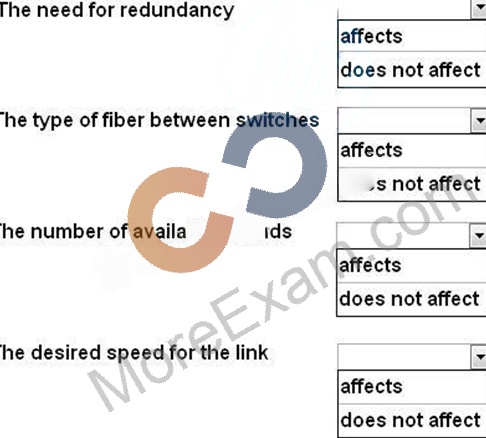
Question5: HOTSPOT
A network architect is choosing transceivers for switches-to-switches fiber links. Which factors affect the architect's choice?
Hot Area:

Question6: A network architect is planning a complete access layer and core upgrade for customer's campus LAN.
The campus has four large buildings, each requiring between 1000 and 3000 edge ports. Which factor will play a primary role in determining whether the network architect needs to plan a two-tier or three-tier topology for the campus LAN?

Question7: Which two requirements of a modern data center make Spanning Tree Protocol (STP) and other traditional loop elimination protocols for that environment?

Question8: An architect is planning an HP Wired-WLAN solution for an office with approximately 4000 users. The solution will have 256 MSM460 APs WLAN controllers. Users must be able to roam seamlessly around the site.
Which strategy meets these needs?

Question9: Customer has a virtualized data center Microsoft Hyper-V Windows Server 2012. The customer has provided this information about the Ms:
Each host has a network (Hyper-V virtual switch) that supports VM productions traffic and owns two

server 10G NICs.
Each host has a network (Hyper-V virtual switch) that supports management traffic to the parent

partition and owns two server Gigabit NICs.
Each rack, the network architect plans to deploy two HP 5920 Series switches, acting as an Intelligent Resilient Framework (IRF) switch.
Which additional information does the architect need in order to plan the connections to each host?

Question10: What is a common management problem in modern networks?
Question11: A customer requires high availability, so the network architect is planning two area border (ABRs) for each non-backbone area in the Open Shortest Path First (OSPF) solution. What ensures a loop-free routing environment that meets the customer needs?

Question12: An implementation plan should include an agreed-on time for the final rollback decision. What should this decision be scheduled?

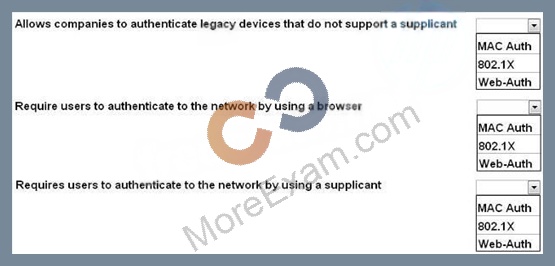
Question13: HOTSPOT
An architect needs to plan a solution that meets customer authentication requirements. Match each authentication method to the appropriate description.
Hot Area:

Question14: A customer is deploying a mobility solution. The IT staff is not experienced in troubleshooting issues with interference and radio frequency (RF) design, and the customer is worried that the wireless connections will not be stable or will not perform well.
Which feature of HP unified Wired-WLAN solutions addresses this customer concern?

Question15: The exhibit shows the topology for an enterprise customer LAN with an on-site data center. The Intelligent Resilient Framework (IRF) group switches supports a group of computers that very high availability to the data center. Therefore the customer has requested a backup that extends directly between the IRF group and the data center core. All of the VLAN interfaces and routed link aggregations that are shown implement Open Shortest Path First (OSPF) in a single area.
Which tasks should the network architect complete to ensure that the HP 5500 IRF group selects the correct path to the data center during (Select two).

Question16: Refer to the exhibit.

The branch routers have E1 lines into the Frame Relay Service provider network. The exhibit shows just one branch, but the network actually has 30 branches. The HP 6600 Series routers, which are the area border routers (ABRs), have E2 lines into the Frame Relay network.
The routers in the exhibit Open Shortest Path First (OSPF). The enable OSPF on network follows:
In area 2, OSPF is enabled on network 10.2.0.0/16

In area 0, OSPF is enabled on network 10.0.0.0/16

The customer requires resilience at the WAN core. Which design change best supports that requirement?

Question17: Data center includes services within the same VLAN and subnet that communicate with each other multicast application. Variable Internet Group Management Protocol (IGMP) on this VLAN on data center switches?

Question18:
A company has several branch offers, each of which has four VLANs: one for employees, one for guests, one for network infrastructure local services. At each office, a VLAN has a maximum of 200 endpoints.
Each branch office represents one Open Shortest path First (OSP) architect has created the plan shown in the exhibit for IP addressing.
What is a potential disadvantage of this design?

Question19: Refer to the exhibit.

A network architect plans to set up intelligent Resilient Framework (IRF) virtual devices as shown in the exhibit, and configure LACP MAD on each IRF. What else should the architect plan in this solution to ensure that the IRF devices work correctly?

Question20: Refer to the exhibit.

The customer requirements include resilience for branch communications. If anyone link fails, a branch can still reach the main office servers. In addition either one of the 5920 switches at the core of the WAN should be able to fail with branches still maintaining their connections.
What should the network architect include in the design to meet this requirement?

Question21: A network architect is explaining the differences between deploying two switches in an HP Intelligent Resiliency Framework (IRF) virtual switch and deploying two switches that implement standard Virtual Routing Redundancy Protocol (VRRP). Which statement correctly describes an advantage of IRF?

Question22: A company is upgrading a data center network solution in phases. The first phase involves updating the top of rack (ToR) switches in one rack. Other switches will be updated in their phases.
What is one benefit of this approach?

Question23: An architect is planning an HP Wired-WLAN solution for an office with approximately 4000 users who will use the wireless network rather heavily and also need to roam seamlessly. The solution will have 256 MSM 460 access points (APs). What is one reason for using two Hp Wired-WLAN controllers for this solution?

Question24: If a network architect is planning a secure device management policy, why would administrators need to generate SSH keys on network infrastructure devices?

Question25: A customer has Voice IP (VoIP) phones that support Link Layer Discovery Protocol Media Endpoint Discovery (LLDP-MED). The phase need to receive their VLAN ID using this protocol. The network architect is proposing HP 5500-48G-PoE+EI switches. Each user computer connects to the phone, which then connects to the Ethernet jack. LLDP is enabled on the switch. Each Edge port is trunk port that permits VLAN 10 (the user VLAN) and VLAN 20 (the voice VLAN).
Which other setting recommended on the edge port?

Question26: Refer to the exhibit.

A network architect is proposing this solution to a customer. The customer network manager has a preference for Cisco VLAN Spanning Tree Plus (PVST+) because this protocol provides for fast convergence when a link fails and also provides per-VLAN load-sharing over links.
How would the network architect explain why the solution fits these requirements?

Question27: A network architect has collected data on link utilization. What is the general guideline the architect should be aware of when analyzing the link utilization data?

Question28: A customer requires high availability for wireless services at branches. The customer also wants to centralize management and traffic distribution as much as possible. What should the architect suggest?

Question29: A customer is installing HP ProLiant DL servers in an enterprise data center and wants to use HP iLO to manage the servers remotely. What is recommended to support the use of iLO?

Question30: Refer to the exhibit.

A customer has the solution in the exhibit, which includes more access layer switches than are shown.
Members of the customer network team mention they are considering access layer routing for a new solution to eliminate Spanning Tree Protocol (STP) and Virtual Router Redundancy protocol (VRRP).
However they are concerned about meaning the routing solution. The network architect proposes a solution that eliminates STP and VRRP without requiring routing at the access layer, although the solution can use access layer routing.
Which solution fits that description?

Question31: A network architect is planning a guest solution for a group of ports in a conference room. Guests should have access to the Internet only. The company wants a simple solution and prefers not to burden visitors with login requests.
Which solution would best meet the company's requirements for a gust network?

Question32: A network architect is designing a redundancy solution for a customer and has learned that there is a single link between two critical network components. During the past 4000 hours of operation, the link has failed twice. The customer estimates that each failure has taken two hours to resolve.
Given this information, what is the availability that this link currently provides?

Question33: A network architect is planning the top of the Rack (ToR) switches for a data center solution. The customer has a hot aisle/cool aisle configuration.
Which characteristic of the switch relates to this plan?

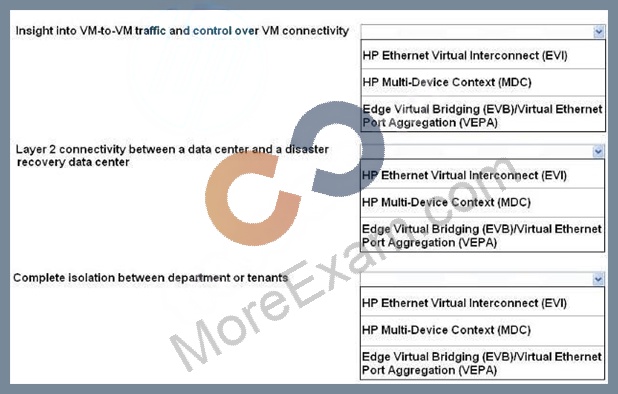
Question34: HOTSPOT
Match the customer need with the HP FlexFabric technology that meets the need.
Hot Area:

Question35: HOTSPOT
Work architect planning the implementation of a solution. For each role, choose whether or not the architect should notify these people and involve them in plan.
Hot Area:

Question36: A network architect is planning to implement SSH to secure management of HP network infrastructure devices. What are the requirements for generating SSH keys on the infrastructure devices and on management stations?

Question37: Refer to the exhibit.

The exhibit shows a proposed design for a data center network infrastructure. The exhibit shows two racks for simplicity. The data center will actually include more racks.
The customer has these key requirements:
The customer can scale any application and easily install new hardware that supports that application

The network supports vMotion for live migration of virtual machine (VMs)

How should the network architect change the proposed design to meet the customer requirements?

Question38: An architect is planning an HP Wired-WLAN solution for an office with approximately 4000 users who will use the wireless network rather heavily and who need to roam seamlessly. The solution will have 256 MSM 460 APs. What is one reason for using two HP Wired-WLAN controllers for this solution?

Question39: What is the preferred time for completing racking and labeling of equipment for a new implementation?

Question40: In the next year, a customer plans to implement reactive Software-defined Networking (SDN) application.
Which technology should the network architect ensure that the proposed network infrastructure devices support?

Question41: Refer to the exhibit.

The exhibit shows how two NICs on a physical server connect to two HP 5820 switches. The server supports eight virtual machines (VMs) with VMware version 5.1. The VMware standard virtual switch is bound to NIC and NIC2. This switch implements source MAC load balancing for the NIC team.
What is the proper configuration for ports 1/0/1 and 2/0/1?

Question42: Which data center characteristics should specifically make the architect consider switches that support Shortest Path Bridging (SPB) or Transparent Interconnection of Lots of Links (TRILL)?

Question43: HOTSPOT
Watch the modules for HP Intelligent Management Center (IMC) to the profile of the customer who needs that solution.
Hot Area:

Question44: What are information technology Service Management (ITSM) frameworks, such as the Infrastructure Technology Infrastructure Library (ITILv3) and The Open Group Architecture Framework (TOGAF)?

Question45: What is a benefit of the HP Dynamic Virtual Private Network (DVPN) technology?

Question46: Refer to the exhibit.

The network architect is planning network addresses for the VLANs shown. The company is using the private 10.0.0.0/8 space. Which guidelines should the network architect follow?

Question47: Which description best characterizes current trends in deploying services for an enterprise?

Question48: A network architect is designing a solution for a customer who wants better security on edge ports.
Recently, an unauthorized individual was able to connect a snooping device to an open port (in other words, to a switch port that is active but not connected to a customer device). The customer wants to prevent this from happening again. However, the customer wants to avoid implementing 802.1X on ports because the IT staff is not prepared to deploy and manage such a solution.
What is the simplest way to minimize the risk of another unauthorized connection without adding a lot of management overhead?

Question49: Refer to the exhibit.

The company wants to use MSTP to handle loop suppression and Layer 2 resiliency. Which design should the network architect recommend to meet this requirement?

Question50: Refer to the exhibit.

The switches in this network are HP ProVision switches.
The network architect plans to set up Core 1 and Core 2 as distributed trunking (DT) switches. What is an advantage of this design?

Question51: A network architect is planning an update of the server access layer in a data center. Currently, the access layer switches have 10G links to distribution layer switches. In the new solution, HP 5930 Switches act as top of rack (ToR) switches with 40G links to core switches.
Which factor must the network architect consider when designing solution?

Question52: A network architect is explaining the differences between deploying two switches in an HP Intelligent Resiliency Framework (IRF) virtual switch and deploying two switches that implement standard Virtual Routing Redundancy Protocol (VRRP). Which statement correctly describes an advantage of IRF?

Question53: Refer to the exhibit.

All connections between switches are 10 Gbps. Switch is an Intelligent Resilient Framework (IRF) group with two member. Switch2 is an IRF group with two members. Switch1 and Switch2 route all traffic.
A network architect is designing a solution for a finance company. One of the primary applications is a multicast application that delivers stock information to IP video screens across the site. The network architect is seeking a multicast solution that meets these needs:
Simple configuration that the customer's IT staff can manage and troubleshoot

No single point of failure for the multicast traffic

What is the best solution for this environment and these needs?

Question54:

A customer has an existing solution, which is shown in Exhibit 1. (The solution actually includes more access layer switches than shown.) In the existing solution, each access layer switch routes traffic.
A network architect is proposing the HP Flex Campus solution shown in Exhibit 2. In this proposed solution, the core Intelligent Resilient Framework (IRF) virtual switch routes traffic but the access layer switches do not. The customer links that in the existing solution if an access layer uplink fails, failover occurs in less than a second.
The customer also likes that the existing solution does not require Virtual Router Redundancy Protocol (VRRP).
What should the architect tell the customer about the benefits of the proposed solution?

Question55: A network architect is planning an intelligent Resilient Framework (IRF) group. What should the network architect implement to protect against a split IRF group?

Question56: A network architect has designed a two-tier topology for the campus LAN and is planning to implement routing at the core. Which requirement might cause the network architect to consider implementing routing at the access layer?

Question57: A network architect is planning to implement weighted fair queuing (WFQ) on an HP 10500 Series switch port. On its own, enabling WFQ on the port does not ensure the correct priority for each queue. What are two important settings to plan?

Question58: A customer wants a simple solution for deploying virtual services at a branch. Which devices support modules running a VMware ESXi hypervisor? (Select two)

Question59:
When does this design benefit a virtualized data center?

Question60: Refer to the exhibit.

The exhibit shows the topology for a network with 30 access layer switches (only two are shown). Every switch-to-switch link is a Gigabit link. Every virtual local area network (VLAN) interface runs Open Shortest Path First (OSPF) and has the IP address shows in the exhibit. The interface settings are at the defaults.
The access layer switches support more VLANs not shown in the exhibit and also run Multiple Spanning Tree Protocol (MSTP) as a protection against loops.
What is one recommendation for enhancing convergence time and resiliency for this solution?

Question61: A network architect has created a quality of service (QoS) for an HP 5900 Series switch that uses four traffic classes. Class of Service (CoS) 5 for voice traffic. CoS 4 for Video traffic. And CoS 0 for everything else. The switch ports implement strict priority (SP) queuing.
What would be an advantage of enabling weighted fair queuing (WFQ) instead of SP?

Question62: A network architect is planning an HP Unified Wired-WLAN solution for an office. The wireless network must support:
4000 concurrent users

Moderately heavy usage

Seamless roaming

IEEE 802.11ac APs

What is one reason for using two HP 10500/7500 20G Unified Wired-WLAN modules as the controllers for this solution?

Question63: What is offered through the Network Strategy and Planning Services?

Question64: HOTSPOT

The network architect is designing an Open Shortest Path First (OSPF) solution and plans to run OSPF on each of the VLAN in switches.
Based on the practices, which interface or interfaces should the network architect plan the features on?
Hot Area:

Question65: Refer to the exhibits.
Exhibit 1

Exhibit 2

A customer has a existing solution, which is shown in Exhibit 1. (The solution actually includes more access layer switches than shown) in the existing solution, each access layer switch routes traffic.
A network architect is proposing the HP FlexCampus solution shown in exhibit 2 in this proposed solution, the core intelligent Resilient Framework (IRF) virtual switch routes traffic, but the access layer switches do not.
The customer likes that in the existing solution STP does not block either access layer uplink. The customer also likes that the existing solution does not require Virtual Router Redundancy Protocol (VRRP).
What should the architect tell the customer about the benefits of the proposed solution?

Question66: What best characterizes the current trend in branch office IT and networking solutions?

Question67: A customer has a virtualized data center with hosts that are managed by VMware vCenter. The network architect has proposed the HP Virtual Application Networks (VAN) Connection Manager (CM) and Resource Automation Manager (RAM) modules for HP Intelligent Management Center (IMC). The architect also proposed the HP 5900v switches and the proper server access layer products.
Which technology must the access layer switches that connect to the virtualized servers support?

Question68: Refer to the exhibit.

A network architect is deciding whether to use a/24 subnet or a/25 subnet for each VLAN shown in the exhibit. What is a valid reason for the architect to decide on a/24 subnet?

Question69: When would a network architect recommend an HP HSR6800 Router for a campus LAN? (Select two)

Question70: The customer has a virtualized data center. The virtual hosts use virtual distributed switches with multiple redundant uplinks and these update control Protocol (LACP).
Which technology available in HP switches enhances high availability in this environment?

Question71: A network architect is planning an 802.1X solution for a company with a Windows domain. The architect and security team plan how to authenticate employees with their user accounts. They also make a plan for authenticating domain computers.
Why should they make this plan?

Question72: An architect is planning an HP Wired-WLAN solution for a customer with Voice over WLAN (VoWLAN) devices, which support 5 GHz and 2.4 GHz, and the laptops. What is a potential advantage of dual-radio
802.1n APs for this environment?

Question73: The HP partner has implemented an HP FlexNetwork solution for a customer. The partner is now giving device inventories and physical and logical topologies to the customer. To which customer role is this information most relevant?

Question74: A customer plans to connect 40 Voice over IP (VoIP) phones and 8 security cameras to a switch:
The VoIP phones are Class 2 PoE devices and require a maximum of 45W (draw a maximum of 5w)

The security cameras are Class 4 PoE+ devices and require a maximum of 17W (draw a maximum of

20 W)
The network architect is proposing an HP 5500-48G-PoE switch, which supports PoE and PoE+ and

has a PoE power budget of 370W
The customer and architect agree on the class form of power allocation

What else does the solution require?

Question75: A customer prefers fixed-port switches at the campus access layer. The network architect wants to propose access layer switches simplifying network architecture and network management.
Which technologies should the network architect consider? (Select two.)

Question76: A data center has a traditional three-tier network design with routing at the distribution layer. The customer is vitalizing its servers and adding technologies such as live migration of virtual machines (VMs).
How well does the architecture (topology) meet the needs of the customer's changing environment?

Question77: Refer to the exhibit.

A network architect has planned redundant links as shown in the exhibit. What should the network architect do to ensure that the redundant link design is truly resilient?

Question78: Company executives believe that the company could benefit from letting employees connect their own devices. The company also has high security pressures. Which approach to BYOD, defined by Gartner, is best for this customer?

Question79: Organizations can deploy off-the-shelf, virtualized application on some HP infrastructure devices. Which devices support this capability? (Select two )

Question80: Refer to the exhibit.

A network architect is designing the logical topology for a campus LAN networking solution. The solution includes:
80 HP 5500-48G EI switches at the access layer

20 access layer Intelligent Resilient Framework (IRF) virtual devices (four members in each IRF)

3840 edge ports total

The solution must support VoIP phones as well as desktop computers.
Which VLAN design shown in the exhibit meets the customer needs and also follows best practices?

Question81: A network architect is designing a solution with HP products. A customer has the following requirements for controlling the management access for administrators:
Administrators are assigned privileges when they log in based on their identity

Security policies related to password complexity and password rotation, like the company's Windows

domain policies, are enforced for administrator credentials
The company can easily revoke the access of administrator how have the company method

Administrator have a backdoor into the management interface in case network connectivity fails in any

way
Which option meets the company's requirements?

Question82: Refer to the exhibit.

A network architect is designing the logical topology for a campus LAN networking solution. The customer requires support for 2400 edge ports, which is provided by 10 intelligent Resilient Framework (IRF) groups at the access layer. This customer does not have a wireless network nor anticipants adding one in the next two years. However, the customer does want to authenticate users with 802.1X and use the network RADIUS server to divide users from different groups into different VLANs. The customer has three user groups, each of which includes between 600 and 900 users.
Additionally, the customer understands that the RADIUS server will require several policies but wants to keep these policies as simple and easy to maintain as possible.
How can the network architect ensure that the solution meets the customer needs and also follows best practice?

Question83: A network architect is using the Network Traffic Analyzer (NTA) module for HP Intelligent Management Center (MC) to evaluate traffic patterns in a campus LAN environment. The network architect hopes to use this information to determine whether the current oversubscription is working well or whether the new plan to have less oversubscription.
What will provide the most useful information for this decision?

Question84:
Which exhibit shows the better Open Shortest Path First (OSPF) area scheme and for which reason?

Question85: Network architect is recommending that a customer move from a three-tier campus LAN topology to a two- tier topology that routes traffic distribution layer provides firewall services and STP root guard. As a best practice, where should firewall services and STP root guard be important topology?

Question86: A service must be available 24x7. It also requires 99.999% availability. How much total downtime can the service tolerate in one year?

Question87: When does an architect need to plan fast roaming for the wireless solution?

Question88:

The customer wants to assign users to VLANs dynamically based on their Windows group. The company Windows Network Policy server provides the assignments. Each of the Windows groups includes between
100 to 600 users.
Which issue does the architect need to resolve?

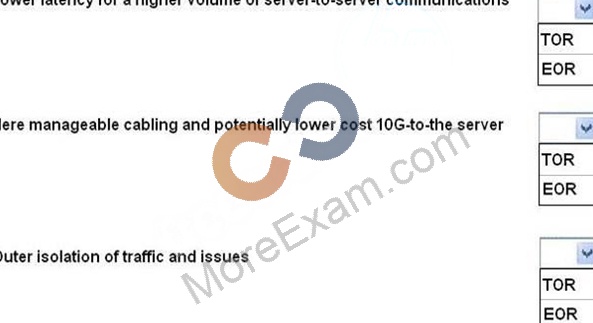
Question89: HOTSPOT
HP data center access layer can use top of rack (ToR) switches or End of Row (EoR)/ Middle of Row (MoR) switches. Select the design with advantage.
Hot Area:

Question90: A network architect is designing as a Multiple Spanning Tree Protocol (MSTP) solution for a network. The network architect plans to create 10 VLANs. The network architect also wants to ensure that the best paths are selected when interoperating with other spanning tree regional.
Which guideline aids in ensuring best paths between regions?

Question91: A hospital CIO tells the network architect that the current network solution is not performing well. The hospital has access layer switches that support 4810/100/1000 Mbps ports and one Gigabit uplink. The hospital is seeking an upgrade to provide better performance and redundancy.
The CIO cannot provide network architect more detailed information about traffic patterns and utilization but does not want the network architect to install intelligent Management Center (IMC) and analyze the traffic.
The CIO does indicate that these applications are important:

Voice over IP (VoIP)

Scheduling and billing application

Patient data logging

Medical imaging

The network architect needs to plan an appropriate oversubscription ratio for access layer uplinks.
What is one piece of information that the architect should collect for this task?

Question92: Which technology, supported by HP FlexFabric solutions, can extend Layer 2 connectivity across a very large data center infrastructure?

Question93: A network architect has planned several validation tests and user acceptance tests (UATs) for a new HP solution. In order to ensure meaningful results, what is one step that the network should complete before implementing the new solution?

Question94: The exhibit shows the topology for a network with 30 access layer switches (only two are shown).Every switch-to-switch link is a Gigabit link. Every area network (VLAN) interface runs. Open Shortest Path First (OSPF) and has the IP address shown in the exhibit. The other interface settings are defaults.

The access layer switches support several more VLANs not shown in the exhibit and also run Multiple Spanning Tree protocol (MSTP) loops.
What is one recommendation for enhancing convergence time and resiliency for this solution?

Question95: Which Flex Fabric product extends HP switch features to virtual hosts and extends HP VAN Connection Manager Benefit to virtualized environments'?

Question96: Refer to the exhibit.

A network architect is proposing an HP 6600 series router at the core of this enterprise customer network.
The router runs Border Gateway Protocol (BGP) and announces the customer networks to the internet service provider (ISP). The router also runs Open Shortest Path First (OSPF) to communicate with the rest of the customer network.
What is an appropriate method for the HP 6604 router to advertise routes to the internet to the other routing switches?

Question97: A data center has several legacy IBM mainframes that only support Systems Network Architecture (SNA) traffic. The mainframes are located in different areas of the data center. What should the network architect plan in this solution?

Question98: Refer to the exhibit.

All switch interfaces shown in the exhibit have these characteristics:
Are configured in routed-mode
Have IP addresses
Run Open Shortest Path First (OSPF)
Network architect wants to ensure that routing switch 1 uses the faster link in preference to the slower link, which should be used in failover situations. Which step should be architect perform to meet this requirement?

Question99: Which benefit does In-Service Software Upgrades (ISSU) provide?

Question100: Refer to the exhibit.

The Intelligent Resilient Framework (IRF) virtual device is the default router for all clients, both wired and wireless. The Unified Wired-WLAN Module controls the Aps, and wireless traffic is distributed centrally. If IRF member 1 fails, which availability issue occurs?

Question101: Organizations can deploy off-the-shelf, virtualized applications on some HP infrastructure devices which devices support this capability? (Select two)

Question102: A network architect has collected data on link utilization. When analyzing link utilization, what is the general guideline?

Question103: What correctly describes one trend that is changing how network architects must design the data center network infrastructure?

Question104: A customer has a virtualized data center. The virtual hosts use virtual distributed switches with multiple redundant uplinks, and these uplinks use Link Aggregation Control Protocol (LACP).
Which technology, available in HP switches, enhances high availability in this environment?

Question105: Refer to the exhibit.

The core routing switches will run OSPF. Which design provides the best failover and resiliency?

Question106: A network architect has planned an 802.1X solution for a company with these requirements:
The solution authenticates employees who connect with wired connections.

The access layer switches are HP ProVision switches.

The core device is an HP Comware Intelligent Resilient Framework (IRF) virtual device.

The authentication server is HP IMC User Access Manager (UAM).

The company wants to keep this solution as it is but also allow the same ports to support guest access.
Instead of authenticating with 802.1X, guests should log in through a Web page hosted on UAM.
Which solution meets this requirement?

Question107: Which scenario would require a company to select HP IMC Enterprise instead of HP IMC Standard?

Question108: A customer has a virtualized data center that uses Microsoft Hyper-V Windows Server 2012. The customer has provided this information about the hosts for the VMs:
Each host has a network (Hyper-V virtual switch) that supports VM production traffic and own two

server 10G NICs
Each host has a network (Hyper-V virtual switch) that supports management traffic to the parent

partition and owns two server Gigabit NICs
In each rack, the network architect plans to deploy two HP 5920 Series switches, acting as an Intelligent Resilient Framework (IRF) switch.
Which additional information does the architect need in order to plan the connection to each host?

Question109: A company recently experienced a data breach when an unauthorized user accessed the network. Which questions should the network architect ask to identify an affective access solution to prevent unauthorized access in the future? (Select two)

Question110: HOTSPOT
A network is choosing transceivers for switch-to-switch fiber links. Which factor affects the architect's choice?
Hot Area:

Question111: For which situation is an optimized three-tier HP FlexCampus topology specifically recommended?

Question112: Refer to the exhibit.

For a campus access layer upgrade, a network architect is proposing HP ProVision switches, which support OSPF, PVST+, MSTP, and distributed trunking. The existing solution uses Cisco devices and Cisco protocols at the distribution layer and core, and will continue to do so. Traffic is routed at the distribution layer. The network operations team is concerned about upgrading and resists learning new protocols.
What is the best plan for this scenario?

Question113: Which application might drive a company to invest in a campus LAN topology that offers lower latency for east/west?

Question114: A switch runs Open Shortest Path First (OSPF) on an interface and needs to establish an OSPF adjacency or adjacencies on that interface. In which situation should the architect pay particular attention to the OSPF hello timer and possibly tune it to a lower value?

Question115: A company experienced a denial of service attack when an infected employee device connected to the network. Which secret devices and prevents them from accessing the network?

Question116: What are information technology Service Management (ITSM) framework, such as the infrastructure Technology Infrastructure Library (ITILv3) and The Open Group Architecture Framework (TOGAF)?

Question117: A network architect is choosing fabric module for an HP 10500 Series Switch. Which factors affect the choice?

Question118: A network is planning the products that interconnect a main site campus LAN, branches, and data center (located at a different site from campus). Which customer requirement would causes the network architect to choose HP enterprise-class modular routers as opposed as deep-buffer switches for this solution?

Question119: Refer to the exhibit.

Compare Design 1 and Design 2 shown in the exhibit. Which description is correct?